

Presentation of the cycle “Towards an Urban Agency as a New Political Institution”
In recent years, we have witnessed innovations across virtually every field: technologies, services, models of collaboration. Yet the institutional framework through which we make the most important political decisions affecting our lives has remained largely unchanged: slow cycles, opaque responsibilities, rigid boundaries between public, private, and civil society. This situation appears even stranger when measured against the epochal changes that have reshaped the horizon in which we live: pandemics, technological accelerations producing continuous creative destruction, forms of violence that exceed any legal constraint, and new intelligences shifting the scope of human control and responsibility. As a result, there is growing distrust not only toward any form of collective solution to individual problems but also toward institutions as devices capable of translating common goals into rules, roles, and responsibilities, while keeping the possibility of public review open. While social innovations surge forward, institutional inventions have struggled to keep pace.
This series of meetings aims to challenge two prevailing ideas: first, the resilience of institutions in the face of contemporary transformations; second, the possibility of activating their inventiveness and energy within the city. Today, many cities function without the public—not in the sense of lacking people, but in that public governance often withdraws while urban form is driven by real estate chains and consumption devices. Squares resemble shopping malls, “open” spaces are governed by private rules, and environmental qualities are designed more to retain customers than to host conflict and difference, producing spaces that appear public but are, in fact, collective under private law. Cameras, forced pathways, usage mixes calibrated for profit, and the mall model transplanted into historic centers—all reflect a long-term shift from the city as an infrastructure for coexistence to the city as a platform for valorization.
Within this context, the democratic circuit is the first institutional system to falter. The public may have strong inputs—electoral mandates, representation—but struggles to turn them into effective outputs (equitable, adaptable results), whereas the private sector produces rapid, tangible outputs without democratic inputs. The challenge is not to choose one over the other but to reconnect the two around a shared public purpose: the ability to direct resources, rules, and projects toward outcomes recognized as beneficial for the community.
Against this backdrop, the series of meetings we propose—organized in collaboration between the Order of Architects of Verona and university research centers—explores what an “urban agency” could be as a city-scale institution: a form capable of keeping pace with transformations in urban form (finance, real estate, platforms, tourism, climate, logistics) while also recognizing and engaging bottom-up innovations (residents’ cooperatives, energy communities, digital mutualism, practices of commons care). Not a prepackaged model, but an institutional workshop channeling diverse energies toward the public purpose. In this sense, an institution is not reducible to a bureaucratic shell but can be imagined as a device capable of absorbing the city’s transformative processes and retranscribing them into rules, roles, usage rights, and responsibilities, while keeping public review open. For an urban agency, “receiving” means intercepting economic, technological, social, and environmental changes and bottom-up innovations; “retranscribing”means giving them a shared, enforceable, and revisable form; and “literacy” means equipping citizens with the tools to participate in city-making: understanding development obligations and compensation, reading specifications, and evaluating who wins and loses when land use changes. More than a top-down moral pedagogy, the urban agency seeks to organize a pedagogy of design: territorial workshops, narrated construction sites, public site visits, visualizations making criteria, alternatives, and trade-offs explicit.
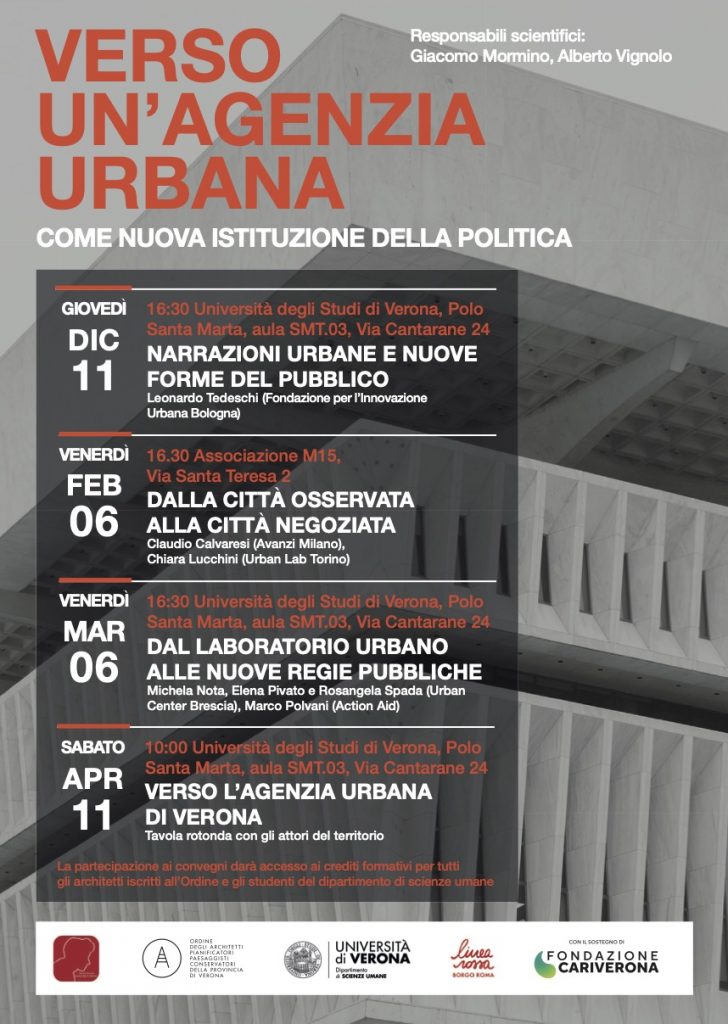
The Arendt Research Center of the Università degli Studi di Verona promotes a series of meetings focused on transformations in urban space and new forms of territorial governance, organized into four sessions between December 2025 and April 2026. The program opens Thursday, December 11, at 16:30 at Polo Santa Marta (Aula SMT.03) with Urban Narratives and New Forms of the Public, featuring Leonardo Tedeschi and Angela Caterini from the Fondazione per l’Innovazione Urbana Bologna; continues on February 6, 2026, at 16:30 at the Ordine degli Architetti di Verona with From the Observed City to the Negotiated City, with Claudio Calvaresi (Avanzi, Milan) and Chiara Lucchini (Urban Lab Torino); resumes on March 6, 2026, at 16:30 at Polo Santa Marta with From Urban Laboratory to New Public Regimes, with Michela Nota, Elena Pivato, and Rosangela Spada (Urban Center Brescia) and Marco Polvani of ActionAid; and concludes on April 10, 2026, at 16:30 with Towards the Urban Agency of Verona, a working session with local stakeholders.
Across these four meetings, participants will hear experiences already practicing urban “retranscription” and literacy—from Bologna to Turin, from Brescia to Milan—culminating in a joint working session. The goal is not to produce a pre-set model but to achieve two concrete outcomes: the creation of a minimal glossary of key terms, shared criteria, and measurable commitments, and the drafting of an initial mandate for a potential city-scale urban agency, clarifying its functions, boundaries, responsibilities, and mechanisms for ongoing public review.